
Industrial Printer Cleaning | Commercial Printing Equipment
Professional dry ice blasting for industrial printers, commercial printing presses, and print shop equipment. Remove ink, adhesive, and overspray buildup without solvents or disassembly. Restore print quality and extend equipment life.
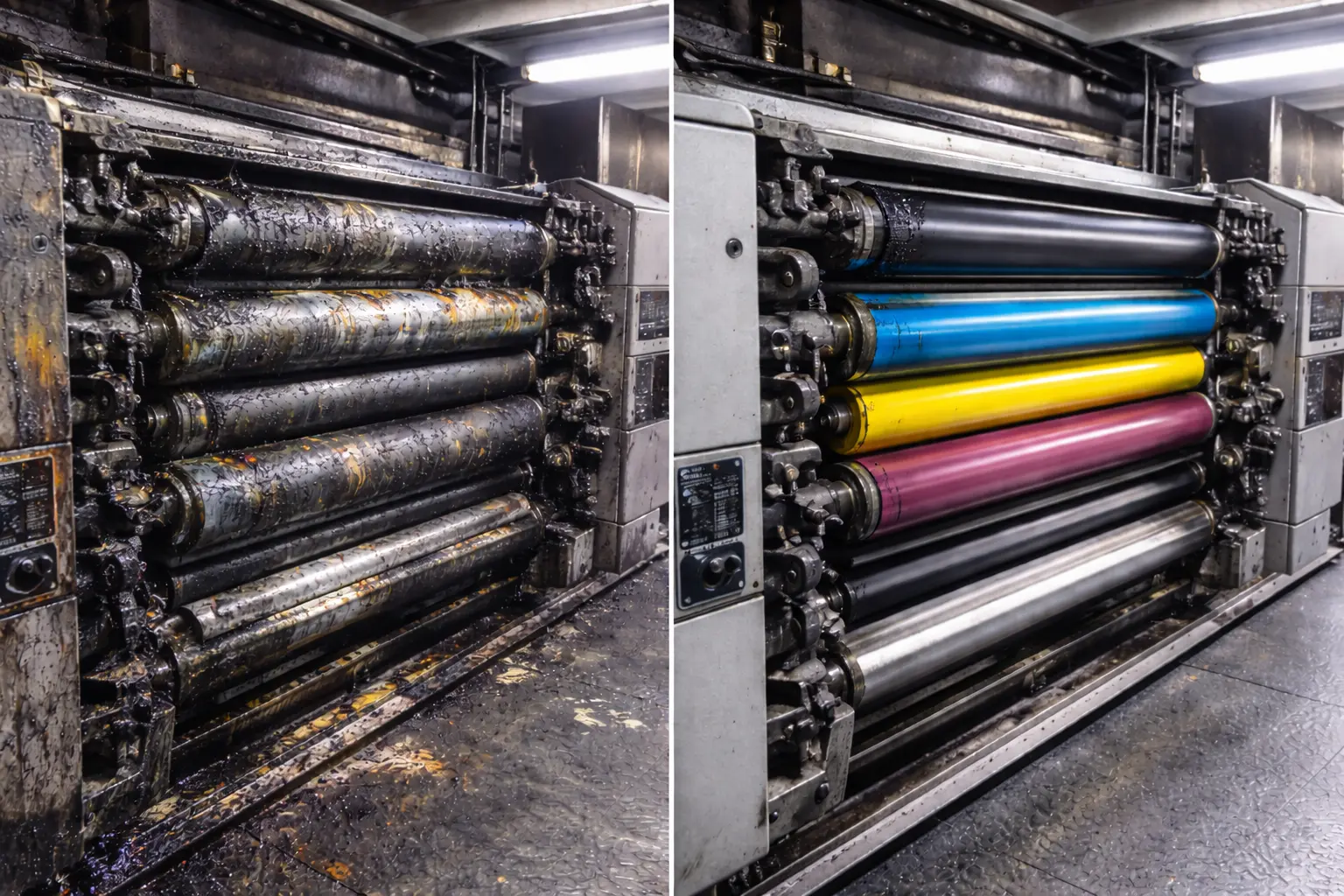
Why Print Shops Choose Dry Ice Printing Equipment Cleaning
Purpose-built for the quality, speed, and uptime demands of commercial printing operations.
Eliminate Solvent Use
Traditional press cleaning relies on petroleum-based solvents that leave residue, create VOC emissions, and require hazardous waste disposal. Our dry ice blasting completely eliminates chemical use—reducing disposal costs, improving indoor air quality, and simplifying environmental compliance. No solvent residue means no contamination risk for subsequent print runs.
Restore Print Quality
Ink buildup on cylinders causes ghosting, dot gain, and color contamination that degrades print quality and increases makeready waste. Our non-abrasive cleaning completely removes ink deposits while preserving cylinder surface finish and engraving detail. Print shops report improved color consistency, reduced hickies, and fewer production interruptions after implementing regular dry ice cleaning.
No Equipment Disassembly
Conventional cleaning requires blanket removal, cylinder extraction, and unit teardown that consumes hours of labor and risks reassembly errors. Our clean-in-place approach accesses printing equipment through existing service points without disassembly. Clean a complete press in a fraction of the time traditional methods require while avoiding the component damage that handling creates.
Maximize Uptime
Print shops operate on tight delivery schedules where downtime directly impacts customer commitments. Our fast cleaning cycle fits within job changes, shift breaks, or weekend maintenance windows without disrupting production schedules. The dry process allows immediate restart without drying time—presses return to production within hours instead of days.
Why Choose Our Industrial Printer Cleaning
- Experience with all major press types (offset, digital, flexo, screen)
- Non-abrasive process preserves cylinder engraving and surface finish
- No solvent residue contamination between jobs or colors
- Fast turnaround fits production schedules and delivery commitments
- Eliminates VOC emissions and hazardous waste disposal
- Improves worker safety by eliminating chemical exposure
Industrial Printing Equipment Cleaning
Comprehensive dry ice blasting for all commercial printing equipment and systems.
Offset Presses
Clean offset printing presses without blanket removal or cylinder extraction.
- Sheet-fed offset presses
- Web offset presses
- Blanket cylinders
- Impression cylinders
Digital Printers
Safe cleaning for digital production presses and toner-based systems.
- Digital production presses
- Large format printers
- Toner systems
- Inkjet equipment
Flexographic Presses
Remove ink and adhesive from flexo presses and anilox rollers.
- Narrow web flexo presses
- Wide web presses
- Anilox rollers
- Doctor blade systems
Screen Printing
Clean screen printing equipment and reclaim screens without chemicals.
- Automatic presses
- Manual presses
- Screen frames
- Drying equipment
Finishing Equipment
Remove adhesive and buildup from bindery and finishing systems.
- Folders & stitchers
- Die cutting presses
- Laminating equipment
- Cutting systems
Ancillary Systems
Clean ink systems, coating equipment, and support machinery.
- Ink trains & rollers
- Coating applicators
- UV curing systems
- Drying ovens
Industrial Printer Cleaning Services
Commercial printing operations demand precision equipment maintenance where contamination directly affects product quality and operational efficiency. Ink accumulation on cylinders causes ghosting and tonal shift, adhesive buildup creates feeding problems, and contaminated rollers transfer unwanted marks to print runs. Traditional solvent-based cleaning introduces its own contamination risks while generating hazardous waste, creating worker exposure concerns, and leaving residue that affects subsequent jobs.
Our industrial printer cleaning services provide print shops with thorough equipment cleaning that maintains precision surface finish while eliminating chemical use and secondary waste. We serve commercial printers, packaging printers, and print shops throughout Dallas, Fort Worth, and across Texas, Louisiana, Oklahoma, and New Mexico.
Offset Press Cleaning
Offset lithography presses accumulate ink on blanket cylinders, impression cylinders, and transfer rollers that degrades print quality through ghosting, dot gain, and color contamination. Our dry ice blasting services clean offset presses in-place without blanket removal or unit disassembly. The gentle cleaning preserves cylinder surface finish and engraving detail while completely removing ink buildup, paper dust, and fountain solution residue that affects print quality.
Digital Press Maintenance
Digital production presses contain sensitive electronic components, toner systems, and imaging drums that require moisture-free cleaning. Our completely dry process safely cleans digital press components without the water introduction that traditional methods create. We remove toner dust, paper debris, and contamination from transport systems, fuser assemblies, and print engine components without damaging electronics or imaging systems that are sensitive to moisture exposure.
Flexographic Applications
Flexographic presses used in packaging and label production accumulate ink and adhesive on anilox rollers, doctor blades, and impression cylinders. Our dry ice blasting services restore anilox cell volume and remove stubborn ink deposits that affect print density and color consistency. The non-abrasive cleaning preserves the fine cell structure of anilox rollers while eliminating the harsh chemical cleaning that can damage laser-engraved surfaces or ceramic coating integrity.
Environmental Benefits
Traditional press cleaning relies on petroleum-based solvents that create VOC emissions requiring environmental permits, generate hazardous waste requiring expensive disposal, and expose workers to chemical vapors creating safety concerns. Our dry ice blasting eliminates solvent use entirely—reducing disposal costs from thousands annually to zero, improving indoor air quality for press operators, and simplifying environmental compliance for print shops in urban areas or near water sources.
Quality Restoration
Print defects often trace to contaminated equipment rather than press adjustment issues. Ink buildup causes dot gain and tonal shift that affects color accuracy, adhesive residue creates feeding problems that interrupt production, and cylinder contamination produces ghosting and hickies that require makeready reprints. Our cleaning services address these root causes by completely removing contaminants that degrade quality. Print shops implementing regular dry ice cleaning protocols report improved color consistency, reduced makeready waste, and fewer customer complaints.
Production Integration
Print shops operate on tight delivery schedules where unplanned downtime disrupts customer commitments and affects competitive positioning. Our clean-in-place approach minimizes production impact by cleaning presses during job changes, between shifts, or during scheduled maintenance windows. The fast cleaning cycle and immediate restart capability mean presses return to production within hours instead of the multi-day shutdowns required for conventional deep cleaning, solvent application, and drying time.